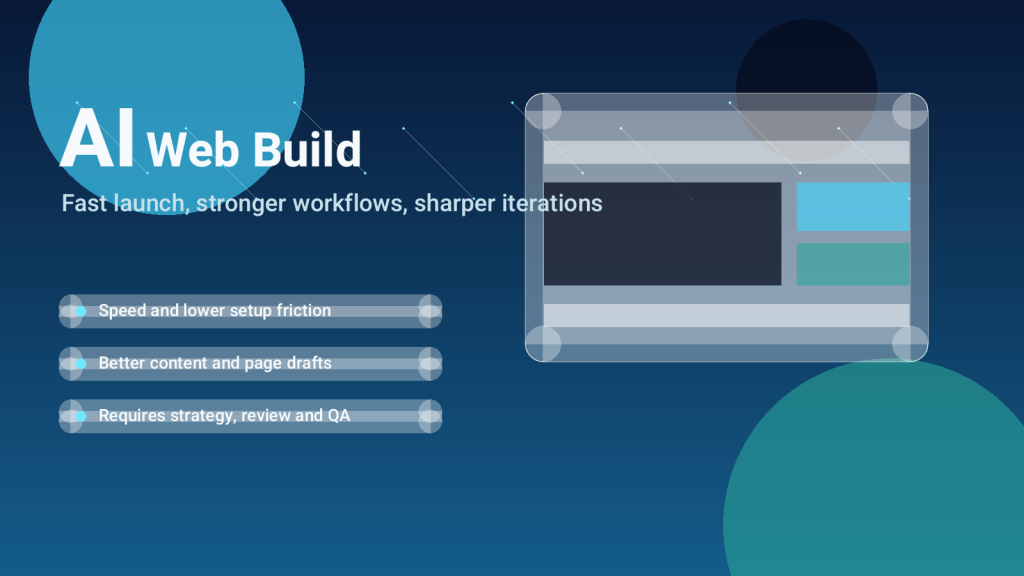
Building a website with AI turned in a short time from a shiny promise into a real tool. Business owners, marketers, designers and developers today use artificial intelligence to write texts, suggest page structures, generate code, refine messages, go live faster and even maintain the site after launch. For those who are at the beginning of the journey, this sounds almost like a perfect shortcut: instead of getting stuck for weeks on characterization, design and development, you can get a first version quickly and improve on the fly.
But the more impressive the tools become, the more important it is to understand the full picture. AI can save time, money and friction, but it is also capable of producing a website that is generic, wrong, inaccurate, insecure or simply not producing a business result. A good website is not just a combination of texts, images and code. It is a system that connects a business goal, user experience, trust, brand, sales process and ongoing maintenance. Therefore, the real question is not whether to build a website with AI, but how to use it intelligently.
Why do businesses turn to building a website with AI
The first reason is obvious: speed. AI tools are able to take a short brief and turn it in minutes into a website skeleton, navigation proposal, home page titles, service texts, FAQs, call-to-action areas and design ideas. For a small business that does not have time to manage a complex project, this is a huge gap compared to the traditional process.
The second reason is availability. Not every business is ready at the beginning to invest a full budget in a designer, copywriter, developer and SEO person. AI lowers the barrier to entry. Even without deep technical knowledge, you can pick up an initial version, understand what is missing, refine messages and go to market faster.
The third reason is flexibility. In the past, a small change on the website required contacting the supplier, characterization, price quote and waiting time. Today it is possible to produce several variations of a title, rewrite a service page, reformulate a product description or propose a new structure for a landing page in a very short time.
The main advantages of building a website with AI
1. Significant shortening of the establishment time
AI excels in the opening stages of a project. He helps draft a brief, suggests a sitemap, writes first drafts and greatly shortens the white page stage. Instead of starting from scratch, the business starts with an editable draft. In practice, this shortens meetings, reduces barriers and speeds up decisions.
The business meaning is clear: you can publish an initial website faster, start receiving traffic, test real marketing language and improve according to actual use. In a world where time to market is a competitive advantage, this is not a marginal detail.
2. Initial cost savings
When AI is used correctly, some of the initial work no longer has to start from scratch with a professional. It can be used for writing service pages, drafting FAQs, creating ideas for an about page, writing product descriptions, automated emails, basic metadata for organic promotion and even preparing an initial characterization document.
This does not mean that you can always give up on professionals, but it does mean that you can reach them with a more prepared base. In many cases this reduces working hours and costs, especially for small businesses or entrepreneurs at the beginning.
3. Accessibility even for non-technical people
One of the biggest changes that artificial intelligence has created is the democratization of website building. Business owners who don’t know code can explain in simple terms what they want, and get a draft to work with. Even if they don’t build the site all by themselves, they are suddenly able to speak a more precise language with vendors.
In other words, AI doesn’t just build things. It also translates a business need into something more technical. This allows the client to understand what he is missing, to distinguish between a home page and a landing page, and to think about the structure of the site earlier.
4. Powerful content writing help
Many websites get stuck not because of development, but because of content. It is difficult to decide what to write, how to explain service, how to balance professionalism with sales, and how to speak at eye level. This is where AI can be very effective. He offers drafts, drafts different versions of the same message, adjusts the tone of voice for different audiences and helps maintain uniformity.
For a business website this is a significant advantage: you can build a base for content faster, then edit it so that it truly reflects the knowledge, experience and personality of the business.
5. Research, SEO, and Optimization Support
AI tools can help with keyword research ideas, organize content clusters, suggest article titles, identify common customer questions, and organize better information hierarchy. They also help draft page descriptions, meta titles, button texts, and service page structures.
When used carefully, it can speed up SEO and content work. It does not replace professional research, but it does reduce the time needed to produce a good initial direction.
6. Acceleration of development and automation
Developers today use AI to write components, draft functions, explain existing code, locate problems, and create technical skeletons. Also in form connections, CRM, automated emails and integrations, AI can significantly shorten repetitive tasks.
For customers, this means that less time is spent on basic technical work and more time can be spent on quality control, user experience, performance and security.
The negative sides that are less talked about
1. Generic sites that look like everyone else
The most obvious disadvantage is genericity. A great many websites built with the help of AI look similar to each other: the same big headlines, the same general promises, the same “techy” images, the same page structure and the same marketing language. Very quickly a reasonable result is obtained, but not unique.
This is especially dangerous for businesses that rely on differentiation, trust and a sense of professionalism. A generic site might go up fast, but it won’t necessarily be remembered. And in a saturated market, recall is a real asset.
2. High confidence even when the content is inaccurate
AI knows how to write in a persuasive tone even when it is wrong. He can draft a service page that sounds great, but includes inaccurate claims, incorrect terms, or promises that the business doesn’t make at all. When it comes to areas such as medicine, finance, law, information security or complex technology, such mistakes can damage trust and even create a real risk.
Therefore, there is no reason to publish automated text without testing. AI is very good in drafts. It does not replace professional responsibility.
3. Real lack of understanding of business strategy
Artificial intelligence knows how to recognize patterns, but it does not live your business. She doesn’t know the customers who ask the hard questions, the reasons why deals fall through, the objections that repeat in the sale, or what really creates trust in your field. It can offer a logical structure, but not always a correct structure.
This is a critical point. A good website is not built only on the basis of what is acceptable in the market, but on the basis of what is appropriate for a particular business, a particular audience and a particular stage of its growth.
4. Code that works, but not always right
When using AI to write code, sometimes you get a dangerous illusion: if it runs, it’s probably fine. In practice the code may be insecure, inaccessible, inefficient, difficult to maintain or breakable in future updates. The more complex the system, the greater the need for serious human review.
This is especially true in forms, user authentication, clearing, integrations, business logic, and customized plugins. AI can help writing, but it does not replace architecture, testing and engineering thinking.
5. Long content that doesn’t really add value
One of the common uses of AI is creating blog articles. The problem is that quantity is not quality. Many texts look professional, but feel empty: clichés, repetitions, general formulations, zero field experience and zero real examples. Search engines as well as human readers become more sensitive to such content.
If the site is filled with generic content written just to “vee” on SEO, it may appear active, but will not necessarily generate trust, dwell time or quality inquiries.
6. Increasing dependence on the tool instead of understanding
There is also a cultural risk. Businesses that get used to getting an immediate answer from AI may stop asking the right questions. They know how to ask “build me a page”, but they don’t always know how to check if the page really supports sales, if the hierarchy is correct, if the message is sharp, and if the user experience makes sense.
The result is dependency. And when you need to maintain, improve, replace a supplier or solve a problem, you suddenly discover that there is not a sufficient understanding of what was built.
Where AI is really strong in the process of building a website
In order to use AI correctly, it is important to understand in which stages it really excels. It’s very powerful at brainstorming, initial page mapping, drafting, refining messages, producing quick variations, documenting processes, creating a code base, researching FAQs, and turning a general brief into an organized working document.
It’s also very good at speeding up repetitive tasks: wording changes, adapting texts to different platforms, creating title variations, building FAQs, drafting system messages, and even identifying problems Basic usability.
Simply put, AI is great as an acceleration engine. It is less good as a final source of authority.
Where human judgment is still required
Business characterization
Before choosing colors, fonts and buttons, you need to understand why the website exists. Is it supposed to generate leads? Filter customers? support sales? Show projects? Strengthen a brand? Without such characterization, even a beautiful website will not bring results.
Differentiation and brand
AI can imitate language. He has trouble producing a truly sharp identity. A good brand is built from familiarity with the market, with the customer and with the real difference between “another supplier” and “the right choice”.
Quality control
Someone must go through the texts, check that all the services really exist, make sure that the links are correct, that the forms are sent, that the content does not make unnecessary promises, and that the website meets the standards of usability, security and accessibility.
Product decisions
Not every feature That AI knows how to produce is worth putting on the website. Sometimes simplicity wins. Sometimes a short page converts more than a long page. Sometimes you need to reduce load, not add more blocks. These are product decisions, not technical completion decisions.
What does the correct process of building a website with AI look like
Step 1: Start from the goal and not from the tool
The most common mistake is to start from the question “Which AI tool will we use” instead of the question “What should the website do”. Setting a clear goal is the basis for everything else. You need to understand who the target audience is, what action you want them to take, what the main objections are and what the message should be.
Step 2: Create drafts quickly
This is where AI comes in strongly. You can ask him for a site map, suggestions for titles, division into pages, drafts for content, suggestions for marketing language and ideas for flow on the page. At this stage, speed is a real advantage.
Step 3: Edit critically
Here you must not skip. You have to go through everything and ask: is it accurate? Does that sound like us? Does that make us different? Is it professionally correct? Is there an unsubstantiated promise here? Is there an unnecessary burden?
Step 4: Developers with control
Even if AI participates in writing code, a developer should check the structure, security, accessibility, performance and maintainability. Fast code without control can be expensive later.
Step 5: Launch and improve based on data
One of the great advantages of the integration with AI is the ability to keep refining. You can check which titles work, which pages generate conversions, where users abandon, and which messages need to be precise. The website is transformed from a one-time product to a system that can be continuously improved.
Who is AI particularly suitable for in website construction?
Small businesses that need to upload a website quickly, entrepreneurs who want to validate an idea, companies that want to produce quick drafts before full investment, marketing teams that need to produce landing pages at a high rate, and developers who want to shorten repetitive tasks. In all these cases AI can be a significant advantage.
However, in complex projects with deep branding, sensitive business logic, complex technical connections, regulatory requirements or a non-standard user experience, it should be used with greater caution. Don’t give up on him, but don’t give him the wheel either.
What happens in the near future
It is very likely that in the near future almost every process of building a website will include AI at some level. It’s already happening. The question is who will use it as a tool and who will let it change their thinking. As the tools improve, the value of human professionalism actually becomes clearer: to choose correctly, criticize correctly, formulate correctly, and understand not only how to produce a page but how to produce a result.
The advantage will not be with those who use AI, but with those who use it better. Those who know how to combine the speed of a machine with business understanding, creativity and human control, will build stronger websites in a shorter time.
Summary
Building a website with AI can be a very smart move. It saves time, lowers entry barriers, shortens repetitive work, helps with content, enables quick experiments and supports maintenance and continued improvement. On the other hand, it may also produce generics, mistakes, dependencies, problematic code and content that is not really convincing.
Therefore the correct approach is not “AI instead of humans”, but “AI within a professional process”. When there is a clear business goal, critical editing, quality control and a correct combination of strategy and execution, you can enjoy the advantages of the tool without falling for its obvious disadvantages.
If you are considering building a new website for your business or want to integrate AI and automation in the digital process, you should start with a real mapping of the business goal and only then choose the tools. That’s usually where the difference between a site that looks good and a site that really works begins.